
On the 6th of August 1915, the 9th (Service) Battalion of the Sherwood Foresters joined the Gallipoli campaign when they landed at Suvla Bay. This month, our blog features some objects in the collection linked to the campaign, to mark the anniversary.
Gallipoli Campaign Overview
The Gallipoli Campaign, part of the First World War (1914-18) was launched in April 1915, to assist the Royal Navy in the area. The goal was to take the Dardanelles, with the aim of being able to launch an attack and take the Ottoman Empire’s Capital; Constantinople (Istanbul). If achieved, this would result in the Ottoman Empire being removed from the war, and help alleviate pressure on Russia, Britian’s ally.
Unfortunately, the Royal Navy’s initial failure to remove the Dardanelle and Gallipoli Peninsula defences meant that the amphibious attack was not a surprise to the Turks. The Force had two landings on the peninsula: the British forces at Cape Helles, and the ANZAC (Australian and New Zealand) Forces at Gaba Tepe (which would later be re-named ANZAC Cove). The French created a diversionary landing at Kum Kale.
Sadly, neither of these two landings were able to reach their goal, with three successive operations to take Kritha being unsuccessful, between 28th of April and 4th of June. Both the British and the ANZACs had failed to advance, and they were soon living in awful trench conditions. The decision was made to send more British troops to Gallipoli.
The 9th Battalion were part of this second wave of troops in August 1915. This was also unsuccessful as the troops were not able to move quickly enough to prove effective, allowing the Turks to establish good defences. There was once again a stalemate. The decision was made to evacuate in December 1915, with all troops evacuated by mid-January 1916.
Objects in our collection
There are three objects related to the Gallipoli Campaign, from our collection, that we shall look at…
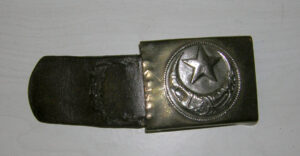
Turkish Waist Belt Buckle
This is an Other Rank’s waist belt buckle of a Turkish Soldier from the Ottoman Empire. It is an M1909 belt buckle and is similar in design and manufacture to those used by Germany also during the Great War. It is a brass belt buckle attached to a white metal circle badge. The badge features a five-pointed star and some Arabic script which is believed to read ‘Asakr-I Shahaneh’ (‘Imperial Army’).
This was taken at Gallipoli by, presumably, a member of the 9th Battalion of the Sherwood Foresters.
5 shot Smith and Wesson Pistol
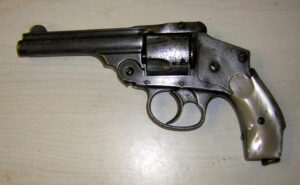
This is a 5 shot Smith and Wesson Pistol. This was taken at Gallipoli, in 1915.
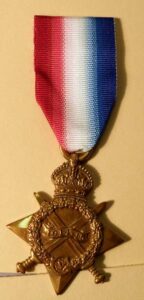
1914-15 Star
This medal was awarded to those who saw service in any theatre of the First World War between the 5th of August 1915 and the 31st of December 1915 (other than those who qualified for the 1914 Star). It was awarded to the British and Imperial Forces, and is bronze with a silk red, white and blue ribbon. ‘1914-15’ is inscribed in the centre.
The medal belonged to (12418) Private Reginald Smith Hood, who served with the 9th Battalion in Gallipoli. Sadly, Reginald was Killed in Action on the 9th of August 1915, during the attack at Chocolate Hill (Ismail Oglu Tepe). He was aged 31 years. Reginald has no known grave but is commemorated on the Helles Memorial, in Turkey.
Price of the Campaign
The Helles Memorial commemorates over 20,000 soldiers who died during the campaign (United Kingdom and Indian forces who died anywhere on the peninsula, Australian forces who died at Helles, and panels for those who died when a troopship sunk off the coast).
There are four other memorials for the missing at Gallipoli: The Lone Pine, Hill 60, and Chunuk Bair, and The Twelve Tree Copse.
Of the 489,000 troops who fought in Gallipoli, 141,500 became casualties and 44,150 were killed.
Liked what you have read?
If you have liked what you have seen and learnt then please donate to our museum fund in the link below. As a museum we are a registered charity (No.1001226) and rely heavily on monetary donations to keep the museum going. Help us to keep the museum and its collection going for future generations and keep sharing the history of The Sherwood Foresters, WFR & Mercian Regiment!
References
‘Belt Buckle, M1909: O/Rs, Turkish Army’, Imperial War Museum <https://www.iwm.org.uk/collections/item/object/30100063> [accessed July 2024].
‘Gallipoli Campaign’, National Army Museum, <https://www.nam.ac.uk/explore/gallipoli> [accessed July 2024].
‘Helles Memorial’, Commonwealth War Graves Commission < https://www.cwgc.org/visit-us/find-cemeteries-memorials/cemetery-details/76100/helles-memorial/> [accessed July 2024].
‘“I won’t miss the flies, or the lice, or the rats, or the good blokes getting killed”- The end of the Gallipoli Campaign’, Commonwealth War Graves Commission <https://www.cwgc.org/our-work/blog/i-won-t-miss-the-flies-or-the-lice-or-the-rats-or-good-blokes-getting-killed-the-end-of-the-gallipoli-campaign/> [accessed July 2024].
Mussel, John W. and Philip Mussel, Medal Yearbook 2009 (London: Bonhams, 2009).
‘Turkish other ranks’ belt buckle: Private C H Livingstone, 6 Light Horse Regiment, AIF’, Australian War Memorial <https://www.awm.gov.au/collection/C109392> [accessed July 2024].
‘What You Need to Know About the Gallipoli Campaign’, Imperial War Museum <https://www.iwm.org.uk/history/what-you-need-to-know-about-the-gallipoli-campaign> [accessed July 2024].
‘WW1 Turkish Soldier’s Belt Buckle’ , The Militaria Dealers <https://www.themilitariadealers.com/en-GB/ww1-uniforms-equipment/ww1-turkish-soldier-s-belt-buckle/prod_10529> [accessed July 2024].