Football and the Foresters

To Celebrate World Football Day, we’ve taken a deep dive into our collection to commemorate a few Sherwood Foresters who brought their love of the sport into the Regiment . . .

Football and the British Army

Sport has always played a crucial role in the British Army and Football has always been one of the most popular games. Across the years, football has been used to improve and promote individual fitness, group morale, and discipline.

Football was also a fundamental part of a soldier’s recreational time and was played at most military bases. It has provided an invaluable distraction from the horrors of war for soldiers serving in front-lines areas and prisoner-of-war camps.

Here at the Museum, our Regimental War Diaries are full of references to football fixtures between platoons, Companies, Brigades, Battalions and also local civilian teams.

A view of the play during the Army football final 1932, 1st Battalion Team. Museum of the Mercian Regiment (WFR Collection), Nottingham: Catalogue number: 2000-3582-43.

Army Cup Winners

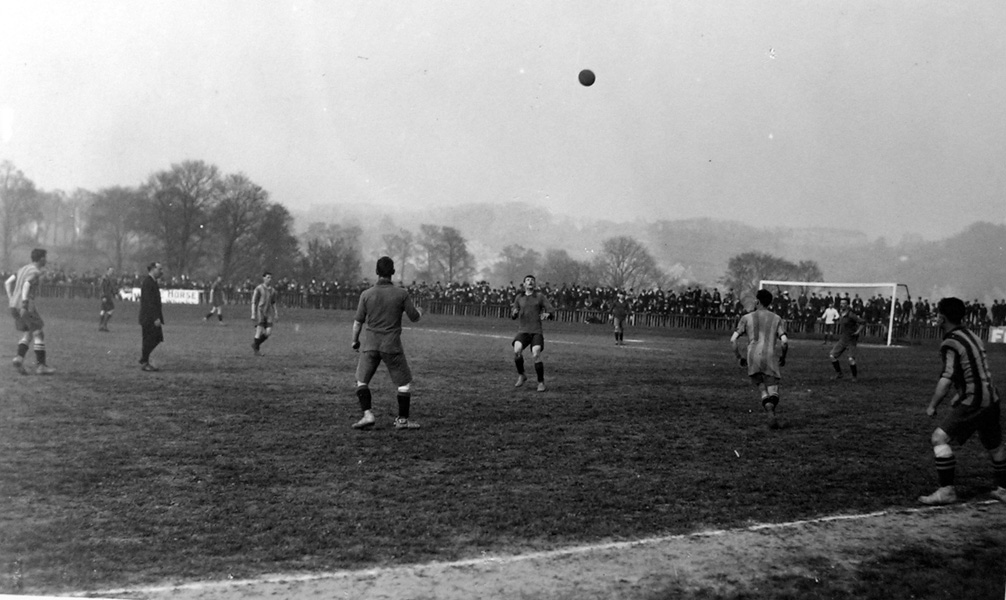
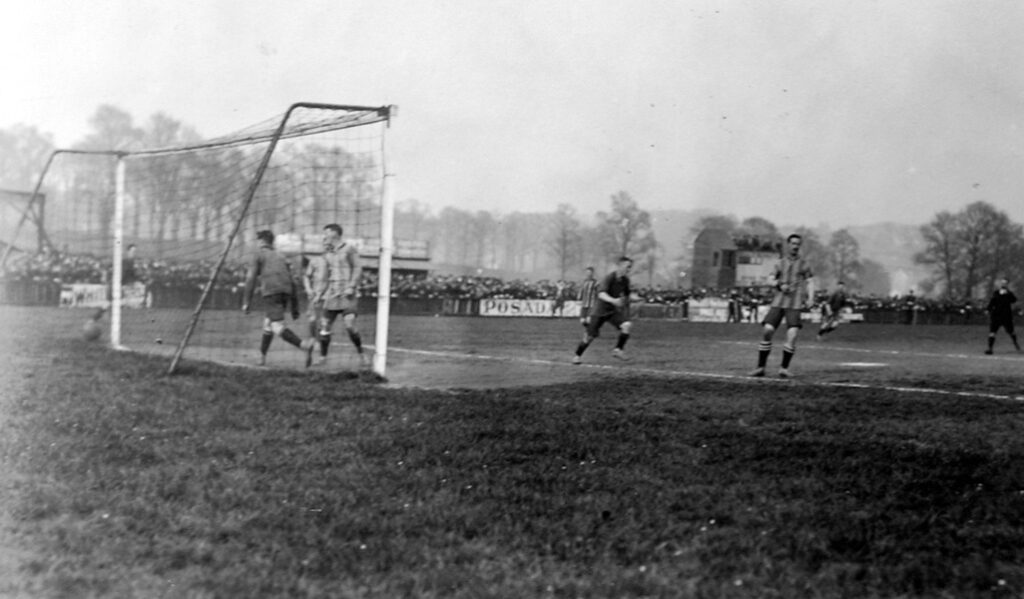
In 1912, the Sherwood Foresters 2nd Battalion Football team won the Army Cup. After making their way through preliminary rounds, the team beat the R.M.A, former holders at Eastney and triumphed against other finalists including the 2nd Battalion Durham Light Infantry.

The match took place on Easter Monday, with men of the battalion arriving in their masses. Their enthusiasm was rewarded not only by a glorious victory, but with the pleasure of seeing the Cup presented by the Colonel of the Regiment, acting for H.R.H the Duke of Connaught.

The Regimental Annual reads: 

“The Colonel praised the team for their fine win, which was only possible by self-denial and arduous training, and emphasised to the younger soldiers that to go about slapping their chests and saying they belonged to the Sherwood Foresters who had won the Army Cup was not good enough, it was their duty to try and do something to bring credit to the Regiment.” Regimental Annual 1912, page 71.

View of the Army Football Cup Final 1912 with the ball well up in the air, 2nd Battalion Team. Museum of the Mercian Regiment (WFR Collection), Nottingham: Catalogue number: 2000-3596-205.
View of the Army Football Cup Final 1912 with the ball in the back of the net, 2nd Battalion Team. Museum of the Mercian Regiment (WFR Collection), Nottingham: Catalogue number: 2000-3596-206.


“Since the 2nd Battalion returned from foreign service in 1902, football has been the most popular sport, and from Commanding Officers down to the last joined boy has been supported in every way. It is therefore all the more pleasing to be able to record that the ambition of all military footballers has at last been achieved by the battalion team in winning the blue ribbon of Army football – the Army Cup – which is now added to the long list of trophies including the Irish Army Cup, upon which the name of the battalion has been engraved.” 

Regimental Annual 1912, page 68.

“The players, fortified with the knowledge that they were as fit as it was possible to be, were confident of victory, and this confidence was shared by the whole of the officers, N.C.O’s, and men of the battalion, who went up to Aldershot en masse on Easter Monday, in a special train charted for the occasion.” Regimental Annual 1912, page 71.

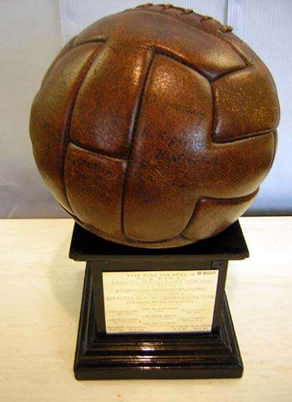
The football used in the final, which became the property of the team, was mounted and presented to Sir Horace by the Commanding Officer at the Regimental Dinner.

The Cup itself, a copy of the Warwick Vase, is a magnificent specimen of the silversmith’s art. Its replica, on a smaller scale but still a fairly large Cup, became the property of the battalion. The players each received a gold medal.

View of the Army Football Cup Final 1912 with the winning team showing off the cup, 2nd Battalion Team. Museum of the Mercian Regiment (WFR Collection), Nottingham: Catalogue number: 2000-3596-210.

Let's take look at a few of our footballers, who contributed to the sporting success of the Regiment . . .

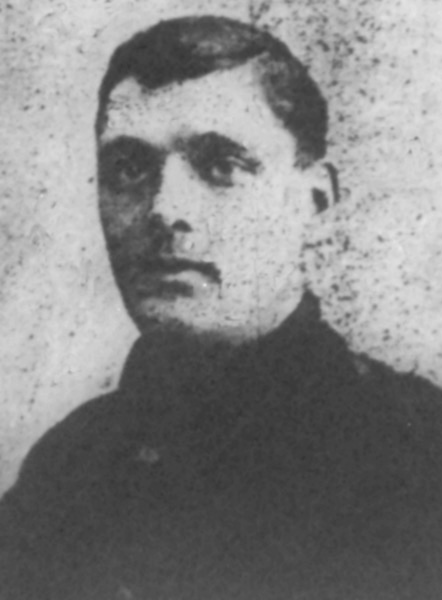
2nd Lieutenant Charles Murray Buchan, M.M

Charles was born on the 22nd September 1891 and became a famous footballer, appearing with several teams. He started with Arsenal, moved to Leyton and then Sunderland, where he remained for 14 years, scoring a total of 209 goals for them. In 1925, he re-joined Arsenal and was capped six times by the England National Football Team.

On the 11th September 1918, Charles transferred from the Grenadier Guards to The Sherwood Foresters Territorial Force, whom he served with for the Great War. He oversaw the football fixtures in the Battalion.

He was awarded the Military Medal, British War Medal and Victory Medal for his service. He sadly died at the age of 68 years on the 25th June 1960.

2nd Lieutenant Charles Murray Buchan, M.M, Museum of the Mercian Regiment (WFR Collection), Nottingham.

Lance Sergeant John W.B. Gillott (18765)

Lance Sergeant John W.B. Gillott (18765), Museum of the Mercian Regiment (WFR Collection), Nottingham.

John was a keen sportsman prior to his enlistment with the regiment. He was born and raised in the town of Heanor, Derbyshire and was employed at Shipley Colliery prior to enlistment.

In addition to playing cricket for Heanor Town Cricket Club, John also played football for a number of different teams including Heanor Old Poplar Grove Eleven and Long Eaton, as well as the Derby County reserves. John brought his love of the sport with him into the 3rd Battalion and was posted to the 2nd Battalion in March 1916.

Sadly, John was killed in action six months later near Guillemont, France at the age of 26 years.  He is commemorated at the Thiepval Memorial in France.

Lieutenant Henry Alfred Cursham

Henry was born in Wilford, Nottingham on the 27th November 1859 and was educated at Repton Public School until the age of 17 years.

Henry was a very skilled footballer and played for Notts County and England. He gained 8 caps for England (scoring 5 goals) and still holds the record with Notts County with 208 goals to his credit. Between 1877 and 1887, he scored 48 goals in the F.A. Cup, a record which has never been beaten.

He was also a notable Cricketer playing for Nottinghamshire between 1880 and 1904. He enlisted with the Robin Hood Rifles on the 18th April 1885. He died at the age of 81 years back home at Holme Pierrepont, Nottingham on the 6th August 1941.

Lieutenant Henry Alfred Cursham, Museum of the Mercian Regiment (WFR Collection), Nottingham.

Private George Glossop (11334)

Private George Glossop (11334), Museum of the Mercian Regiment (WFR Collection), Nottingham.

George Glossop was a member of the 1st Battalion football team. He was born in Ilkeston and enlisted with the 1st Battalion in 1914. He embarked for France with the battalion on the 4th November 1914.

In September 1915, George and his team played against the Black Watch, the 3rd Battalion Scottish team. Around 1000 spectators were watching the game when a German aircraft bombed the game. Miraculously, there were no casualties and the Black Watch concluded the game with a 2-1 victory. George continued to play football until his death later that year, when he was killed in action during an attack on La Boiselle (Somme), France, aged 25.

Lieutenant Colonel Bernard William Vann V.C., M.C.

Bernard was born on the 9th July 1887, at Rushden in Northamptonshire. He was a very enthusiastic sportsman at college and was a Hockey Blue at Cambridge. He played football for several Association League Teams including Northampton, Notts County, and Mansfield.

At the outbreak of the Great War, Bernard applied for an Army Chaplaincy but, impatient of the delay in being given a position, he took a commission into the 8th Battalion the Sherwood Foresters in August 1914. In 1915, he was awarded the Military Cross and Bar to the Military Cross in 1916. In February 1917, he was awarded the French Croix de Guerre with Palm.

He was wounded  in July 1916, at Bellacourt and later joined the  9th Battalion at Bapaume on 30th April 1917. He was appointed Lieutenant-Colonel of the 6th Battalion Sherwood Foresters and was awarded his Victoria Cross for action taken in September 1918. Bernard went on to lead his battalion until he was killed on the 3rd October 1918, by a German sniper whilst leading his men forward into the attack on  the village of Ramicourt.

In addition to his Victoria Cross, Military Cross and Bar, and Croix de Guerre with Palm, he was awarded the 1914/15 Star, British War Medal and Victory Medal.

Lieutenant Colonel Bernard William Vann V.C., M.C., Museum of the Mercian Regiment (WFR Collection), Nottingham.

Commemorating their Achievements

Here at the Museum of the Mercian Regiment, we have around 300 objects relating to regimental football. Our collection is packed full of football paraphernalia, here are a few examples . . . 

Unnamed brass football medal, won when in Ireland. Museum of the Mercian Regiment (WFR Collection), Nottingham: Catalogue number: 1998-2772.
Football mounted on a plinth, football used in the 1911 Army Final won by 1st Battalion. Museum of the Mercian Regiment (WFR Collection), Nottingham: Catalogue number: 1998-1973.
A pair of leather football boots used by Drummer G. Jackson during his service with the 2nd Battalion in Gurnsey, 1936-1939. Museum of the Mercian Regiment (WFR Collection), Nottingham: Catalogue number: 2010-7674.

Want to learn more about the history of Football in the British Army?

Follow these links:

https://www.iwm.org.uk/history/9-facts-about-football-in-the-first-world-war


https://www.iwm.org.uk/history/voices-of-the-first-world-war-sport-in-war


https://www.nam.ac.uk/whats-on/football-and-war-women-football


https://www.nam.ac.uk/explore/sport-and-morale-british-army


https://www.nam.ac.uk/explore/british-army-and-evolution-sport

Liked what you have read?

If you have liked what you have seen and learnt then please donate to our museum fund in the link below. As a museum we are a registered charity (No.1001226) and rely heavily on monetary donations to keep the museum going. Help us to keep the museum and its collection going for future generations and keep sharing the history of The Sherwood Foresters, WFR & Mercian Regiment! 

References: 

Museum of the Mercian Regiment (WFR Collection), A view of the play during the Army football final 1932, 1st Battalion Team. Nottingham: Catalogue number: 2000-3582-43. 

Museum of the Mercian Regiment (WFR Collection), Football Medal. Nottingham: Catalogue number: 1998-2722.

Museum of the Mercian Regiment (WFR Collection), Football mounted on a plinth, football used in the 1911 Army Final won by 1st Battalion. Nottingham: Catalogue number: 1998-1973.

 Museum of the Mercian Regiment (WFR Collection), Pair of leather football boots used by Drummer G. Jackson during his service with the 2nd Battalion in Guernsey, 1936-1939.  Nottingham: Catalogue number: 2010-7674.

Museum of the Mercian Regiment (WFR Collection),View of the Army Football Cup Final 1912 with the ball well up in the air, 2nd Battalion Team. Nottingham: Catalogue number: 2000-3596-205.

Museum of the Mercian Regiment (WFR Collection),View of the Army Football Cup Final 1912 with the ball in the back of the net, 2nd Battalion Team. Nottingham: Catalogue number: 2000-3596-206.

Museum of the Mercian Regiment (WFR Collection),View of the Army Football Cup Final 1912 with the winning team showing off the cup, 2nd Battalion Team. Nottingham: Catalogue number: 2000-3596-210.

Regimental Annual: The Sherwood Foresters, Nottinghamshire and Derbyshire Regiment, 1912. Museum of the Mercian Regiment (WFR Collection), Nottingham: Catalogue number: 2003-6146-4.