16th (Chatsworth Rifles) Battalion The Sherwood Foresters (Nottinghamshire & Derbyshire) Regiment
Captain Arthur Stanley Mellor was born in about 1898, in Nottingham. He was the son of Edwin and Anne Mellor. He had five siblings, four sisters and one brother. The family lived at 58 Addison Street in Nottingham.
Arthur joined the 3/7th Battalion of the 7th of November 1915, to serve in the Great War (1914-18). This was only a few months after the Battalion had been formed, in February 1915. The Battalion spent some time in the latter months of the year at Belton Park near Grantham. After the Easter Rising in 1916, the battalion concentrated on coastal defences. On the 18th of October, Arthur was struck off the strength of the Battalion to join the British Expeditionary Force in France.
Arthur joined the 16th (Chatsworth Rifles) Battalion on the 9th of November 1916. They saw much action in the Ypres Salient over the years 1916 and 1917, and Arthur became a Lieutenant on the 1st of July 1917. Arthur was wounded several times during this service. He was wounded at Kitcheners Wood on the 31st of July 1917 and on the 15th of August 1917, when his collar bone and three ribs were broken and he suffered a piece of shrapnel through the upper part of his chest.
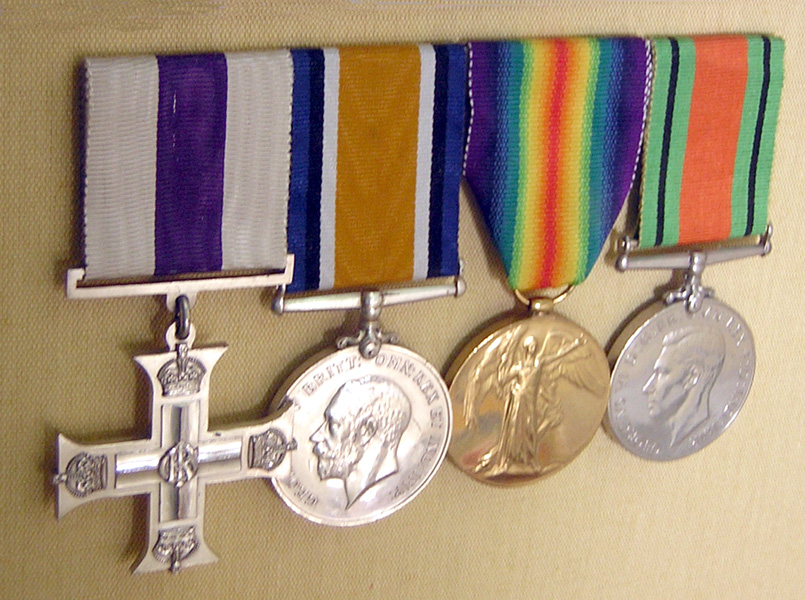
In early August, Arthur displayed great gallantry, and was subsequently awarded the Military Cross (MC). This was reported thusly, in the London Gazette on the 26th of September 1917: ‘During a hostile attack on our trenches at La Coude Paille on 5.8.1917, he led a party along a sap under heavy fire and took the raiding party in flank, bombing them with enemy bombs. His prompt action caused the enemy many casualties, taking them by surprise and preventing the raid from effecting an entry to our main trench., although within twenty yards of it at one moment. He set a splendid example of promptness and courage, and was wounded in doing so.’ Arthur was invalided to England a few months later in October 1917.
He also served during the Second World War (1939-45), likely in the Home Guard.
Medals
Conflicts