
In the month of December, in the UK, we often look ahead to the festive holiday of Christmas. At the beginning of the Great War (1914-18), it was thought that the war would be over by the holiday. It must have slowly begun to dawn on the soldiers that they would not be having their ‘usual’ Christmas day.
Princess Mary, the only daughter of King George V and Queen Mary, also had the realisation that the soldiers would not have returned home by the 25th of December. Princess Mary gave her name to a public fund, to raise money so that every soldier and sailor would have a Christmas present. More than 2 million were distributed.
As it is December, we thought we would take a look at the Princess Mary Christmas Tins in our collection and think of the soldiers who received these presents.

The tins were given to the soldiers containing various items including tobacco, writing packets, pencils and chocolate.
Kept within Reginald Henry Ford’s tin, in our collection, are newspaper cuttings about his distinguished career as a soldier.
We thought it would be interesting to delve into the service life of Reginald due to his newspaper cuttings being kept inside his Christmas Tin; they are both part of the memory of him and his service.
Reginald Henry (“Harry”) Ford was born in 1896, in Shardlow, Derbyshire. Reginald enlisted in Derby and, as his tin reveals, served during the Great War of 1914-18. He joined as part of the 2nd 5th (2/5th) Battalion of The Sherwood Foresters, that were formed on the 16th of October 1914. The Battalion trained in Luton and later Watford in 1915, in preparation for going to France.
However, Reginald first served with the 2/5th Battalion in Dublin, due to the Easter Rising of 1916. He did not arrive in France until 1917.
Reginald would serve in France with exemplary gallantry and would be awarded with not just the Military Medal (M.M) but also the Distinguished Conduct Medal (D.C.M). The latter being considered a superior decoration since 1916, but both medals are associated with acts of bravery and heroism.
Both his D.C.M and M.M were published in the London Gazette, on the 30th of October 1918 and on the 28th of January 1918 (it should be noted that the Gazette did not publish awards like this immediately; this would explain why the M.M, which Reginald was awarded first, was not published before his D.C.M). However, the newspaper cuttings contained within Reginald’s Princess Mary Christmas Tin are likely from the Derbyshire Mercury.
Reginald was awarded both the M.M and D.C.M whilst serving in France.


‘SHARDLOW SERGEANTS GALLANT CONDUCT
Sergt. R. ford, who some time ago won the M.M., has been awarded the D.C.M. for further conspicuous bravery in the last fighting at Kemmel. The following is an extract from the report given by the officer in command: – “A tremendous lot of work came on the shoulders of my N.C. Officers. Sergt. Ford, under the hottest machine-gun fire and sniping, crawled out in broad daylight to get in touch with the posts in his left… He handled his men with rare skill and cheerfulness. It was the same at Ypres where he won the M.M. Here… he refused to leave his Lewis gun, although slightly wounded, even to eat or drink, till he was forcibly removed by his platoon commander.’
It is likely that Reginald was with the 2/5th when he was awarded the M.M and D.C.M.
However, Reginald did later join the 1/5th Battalion, as he sadly lost his life whilst serving with them near Pontruet, France on the 24th of September 1918.
Reginald’s second newspaper clipping within his Princess Mary Tin, refers to his sad passing.
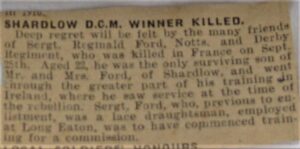
‘SHARDLOW D.C.M KILLED.
Deep regret will be felt by the many friends of Sergt. Reginald Ford, Notts. And Derby Regiment, who was killed in France on the Sept. 25th Aged 22, he was the only surviving son of Mr. and Mrs. Ford, of Shardlow, and went through the greater part of his training in Ireland, where he saw service at the time of the rebellion. Sergt. Ford, who, previous to enlistment, was a lace draughtsman, employed at Long Eaton, was to have commenced training for a commission.’ *
Reginald is buried at Bellicourt British Cemetery, VII.L.2., France. His grave bears the personal inscription of “Thy Will Be Done”.
Reginald receiving the Princess Mary Christmas Tin
The Princess Mary Fund, as mentioned above, was designed for those overseas to receive a Christmas Present in 1914. Reginald, as previously stated, was still training in the United Kingdom at this time. The fund had actually raised a surplus of money, more than enough for those serving abroad for Christmas 1914 and so the eligibility of the Princess Mary Tins was widened to include those serving at home, Prisoners of War (POWs) and the next of kin of the 1914 casualties. Not everyone received the Christmas Tin on Christmas Day, but the majority are believed to have been delivered by January. It can be assumed that Reginald received his as a late Christmas Present in 1915.
*It must be noted that the newspaper clipping made an error with Reginald’s date of death being on the 25th, when it was the 24th. This is why the dates do not match.
Liked What you have Read?
If you have liked what you have seen and learnt then please donate to our museum fund in the link below. As a museum we are a registered charity (No.1001226) and rely heavily on monetary donations to keep the museum going. Help us to keep the museum and its collection going for future generations and keep sharing the history of The Sherwood Foresters, WFR & Mercian Regiment!