The Tirah Campaign took place on the North-West Frontier in India (now Pakistan), in 1897-1898 and was in response to the uprising of the Pathan Tribes. At the time the region was part of the British Empire and the Tirah Campaign was the largest operation to quell the rebellion with 35,000 troops.
On the 20th of October 1897, the 2nd Battalion participated in the storming of the Dargai Heights as part of the Tirah Campaign. Lieutenant Henry Singleton Pennell was awarded a Victoria Cross for his gallantry displayed during this action.
Here at the Museum of the Mercian Regiment, our archive holds the photographic albums of the 2nd Battalion, which document the action taken on the North-West Frontier. Let’s take a look at how the events unfolded . . .
The Durand Line
In 1893, a boundary agreement was formalised between British diplomat Sir Mortimer Durand and Afghan Emir Abdur Rahman Khan to define British India and Afghan spheres of influence. This 1,6000-mile international border spanned between Afghanistan and British India, now Pakistan, and was named the Durand Line after Sir Mortimer Durand.
The boundary agreement caused growing resentment throughout the tribes and was later rejected by the Afghans, who continued to view the region as their own. The boundary cut through numerous tribal areas and in doing so, divided communities with shared cultures and threatened their ways of life.
The largest ethnic group which inhabited the North-West frontier were Pathans, who consisted of several indigenous tribes including the Afridi, Waziris, Orakzais, and Mahsuds. The Afridi, who primarily inhabited the Khyber Pass area, had a fearsome reputation for fighting. They inhabited an area of 900 square miles and were believed to consist of around 30,000 trained fighting men. By comparison, the Orakzais had 25,000 men in the field. These Pathan tribes proved to be fierce opponents due to their skill in shooting and warfare tactics, which were well-suited to the mountainous and barren environment.

In 1894, the Boundary Commission began their labours at the Southern end of the new line in Waziristan with an escort of 3,000 men and six guns just to assist. The Waziris grew uneasy, gathered their forces, and fell fiercely on the camp at Wana.
In response, a British Indian force was promptly dispatched under Lieutenant-General Sir William Lockhart, which swept through the country raiding cattle and laying waste to villages. Following the conflict, the boundary was then completed through the territory.
By 1897, the majority of Pathan tribes had joined the uprising. In particular, the Afridis and Orakzais attacked several forts and captured posts in the Khyber Pass area.
The Tirah Campaign (1897-1898)
In mid-September 1897, the 2nd Battalion of the Sherwood Foresters joined the expeditionary force and took part in the offensive against the Afridis and Orakzais in Tirah. On the 17th October 1897, orders were issued by Lieutenant-General Sir William Lockhart for the advance of the force into Tirah to be begin on the 20th October. A total of 35,000 troops were mounted, including the 1st Gordon Highlanders, 1st and 2nd Gurkhas, Dorsetshire Regiment and Sherwood Foresters.
Originally intended to take place 10 days prior, the opening offensive operation was delayed until the 20th October 1897. This was due to immense difficulty faced whilst sourcing pack animals. As a result, authorised baggage allowance became extremely restricted with an officer being allocated 54lbs of baggage and a soldier with no more than half that amount. Field and staff officers rejoiced in a whole mule to themselves, whilst the ordinary regimental officer shared his mule with two others, and one mule carried the entire belongings of six British soldiers.
As the shortage of mules restricted what equipment could be brought into the field, tents were out of the question and troops were forced to make do with a limited wardrobe and blankets in the considerable cold.


The troops marched in khaki uniform with puttees (a covering for the lower part of the leg from the ankle to the knee), and their coats were rolled on their backs below their mess tins. Each man was allowed to bring:
- A Waterproof sheet
- Three blankets
- A cardigan jacket
- A sleeping cap
- Serge trousers
- A flannel shirt
- A pair of socks
- Mitts
- Boots
- A great-coat, to be carried together on separate mules
The remainder of the men’s kit was left behind with the tents and heavy baggage at Shinawari and was forwarded to them at Mastura three weeks later.
On the 20th October, forces left the camp at 4:30am and began marching through the Samana Mountain range. The men covered a total of 5 miles of mountainous terrain in four hours before reaching the mountain pass of Chagru Kotal.
By the time the Sherwood Foresters reached Chagru Kotal, a total of 12,000 Afridis and Orakzais tribesmen had occupied Dargai Heights – a steep ridge with an elevation of approximately 6600 feet, 1100 feet above Chagru Kotal. A direct attack was quickly launched with the 2nd Gurkhas leading, supported by the Dorsets, with the Gordons in reserve. The Sherwood Foresters formed the third line of attack and also fired long range volleys at 1200 yards from the village of Mamu Khan to provide cover for the Dorsets’ attack.


Troops were forced to navigate narrow single-track paths that zigzagged up steep and impassable terrain. With little shade and steep climbing, the men were forced to sit or lay down at intervals to catch their breath. The troops were forced through a bottle neck in the rock, which only allowed for two or three men at once. After passing through the narrow passage, the men found themselves on the end of a narrow ledge, which left them exposed to heavy enemy fire.
Upon reaching the gap, the Sherwood Foresters were met with a block of around 300-400 men tightly jammed together with many wounded amongst them.


Captain A.K. Slessor described the scene:
“Half a mile of crest, thickly studded with an invisible enemy, who were deadly shots at 800 yards, and who at this short distance made every other shot tell. Such was the position that had to be captured from a numerous and powerful enemy, equipped largely with modern rifles and sheltered behind stone sangars which three mountain batteries (and occasionally a fourth) pounded for nearly five hours with no appreciable effect. A more veritable death-trap it is impossible to conceive.”
After suffering heavy losses, rapid and concentrated artillery fire provided cover as the Gordons, Gurkhas, Dorsets and Derbys rushed the pass, and the ridge was eventually stormed.
Lockhart’s force fought its way into Tirah before establishing a camp at Maidan. The expedition lasted until January 1898 and cost the British 287 dead and 853 wounded.
Want to learn more about the Tirah Campaign?
Follow these links:
https://www.stand-firm-strike-hard.org.uk/victoria-cross-at-st-quentin
https://www.nam.ac.uk/explore/north-west-frontier-india
https://collection.nam.ac.uk/detail.php?acc=1957-05-28-1-17
Liked what you have read?
If you have liked what you have seen and learnt then please donate to our museum fund in the link below. As a museum we are a registered charity (No.1001226) and rely heavily on monetary donations to keep the museum going. Help us to keep the museum and its collection going for future generations and keep sharing the history of The Sherwood Foresters, WFR & Mercian Regiment!
References:
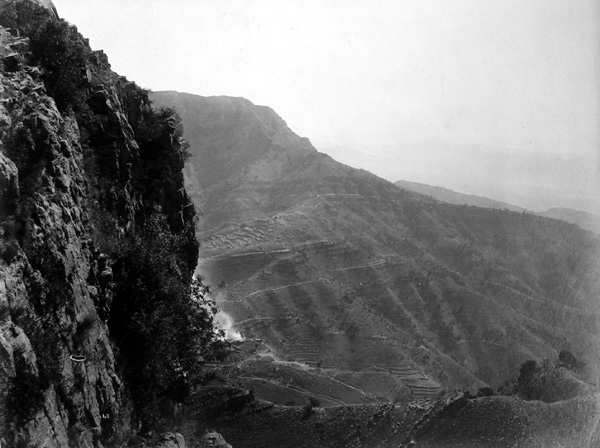
Museum of the Mercian Regiment (WFR Collection), photograph of view of villages burning, taken during the Tirah Campaign, 1897. Nottingham: Catalogue number: 2000-3564-99.
Museum of the Mercian Regiment (WFR Collection), photograph of view of unnamed officers of the 1st Brigade of the Tirah Expedition Force, circa 1897. Nottingham: Catalogue number: 2000-3564-47.
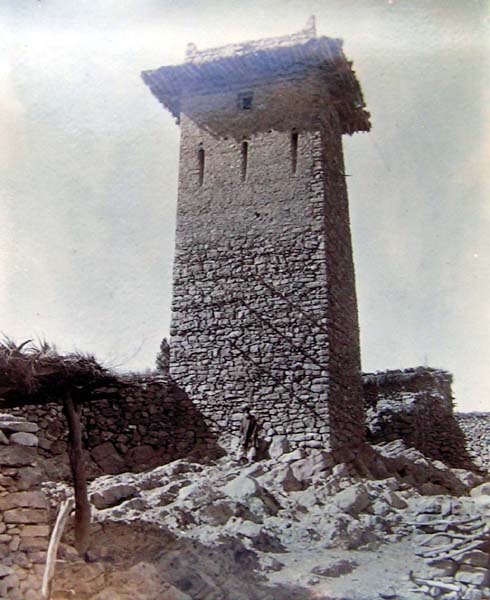
Museum of the Mercian Regiment (WFR Collection), photograph of the Tower on the Chugru Kotal, circa 1897. Nottingham: Catalogue number: 2000-3640-3.
Museum of the Mercian Regiment (WFR Collection), Photograph of view taken during the Tirah Campaign from Dargai Cliff (enemy’s position) looking down towards the Fatal 150 yards, 1897. Nottingham: Catalogue number: 2000-3564-103.
Museum of the Mercian Regiment (WFR Collection), photograph of view looking down on Fatal Ridge from the enemy’s left centre position. Our companies were firing from near the trees on left – the rushes were all made over the gap to right of trees where there is a white speck, 1897. Nottingham: Catalogue number: 2000-3640-8.
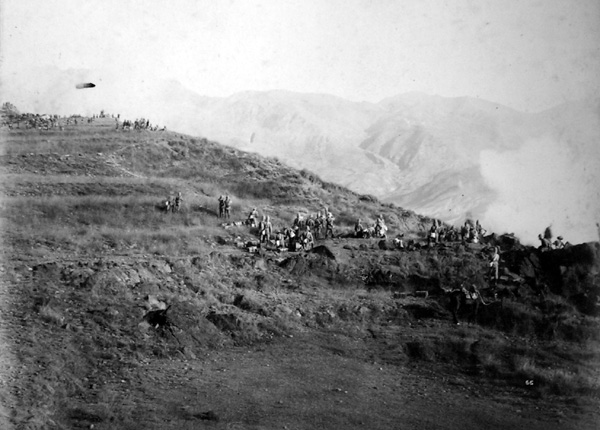
Museum of the Mercian Regiment (WFR Collection), Photograph of view taken during the Tirah Campaign, Batteries shelling the enemy on Sampagha Pass, 1897. Nottingham: Catalogue number: 2000-3564-112.
Museum of the Mercian Regiment (WFR Collection), Photograph of Durgai with Fatal Ridge, 1897. Nottingham: Catalogue number: 2000-3640-7.
Slessor, Captain A.K. ‘The 2nd Battalion Derbyshire Regiment In Tirah’. London: Swan Snnenschein & Co, 1900.