The Foresters and their Four-legged Friends

To celebrate International Dog Day, we thought we would take a look at how our four-legged friends have served their country . . .

Animals have always played a key role in conflict throughout history. Over 16 million animals are estimated to have served during the First World War alone. Animals of all shapes and sizes were called upon to serve their country during both the First and Second World War and many conflicts since. Dogs, cats, pigeons, horses, donkeys, glow worms, camels, monkeys, elephants, pigs, and bears were all deployed across the globe.

Dogs in particular made a substantial contribution to the war effort by undertaking a wide range of tasks. They undertook search and rescue missions to locate and retrieve the wounded, they relayed messages, laid communication lines, managed pests in the trenches, boosted morale in Prisoner of War camps, and even helped to smuggle soldiers out of German-occupied Belgium during the First World War.

Photograph of a street scene at Kortrijk, France, Circa 1914-1918. Museum of the Mercian Regiment (WFR Collection), Nottingham: Catalogue number: 2000-3637-90.

Ambulance Dogs in the First World War

During the First World War, around 20,000 dogs were trained for front-line duty. Whilst the majority were highly trained Police dogs, many were rehomed from animal shelters and around 7,000 were beloved family pets.

They contributed to the war effort by working as Ambulance dogs, also commonly referred to as Red Cross, Mercy or casualty dogs. These dogs were sent out across the battlefields to search for wounded soldiers and alert the ambulance units. In order not to alert the enemy, the dogs were trained not to bark. Instead, they returned to their handlers after finding an injured soldier with a piece of clothing or object in their mouths to signal a successful find.

Being faster and more agile than their human handlers, the dogs were in many ways more suited to trench warfare and often went into no-man’s land to locate the wounded. By providing immediate help to individuals who were often out of reach, these dogs saved countless lives.  

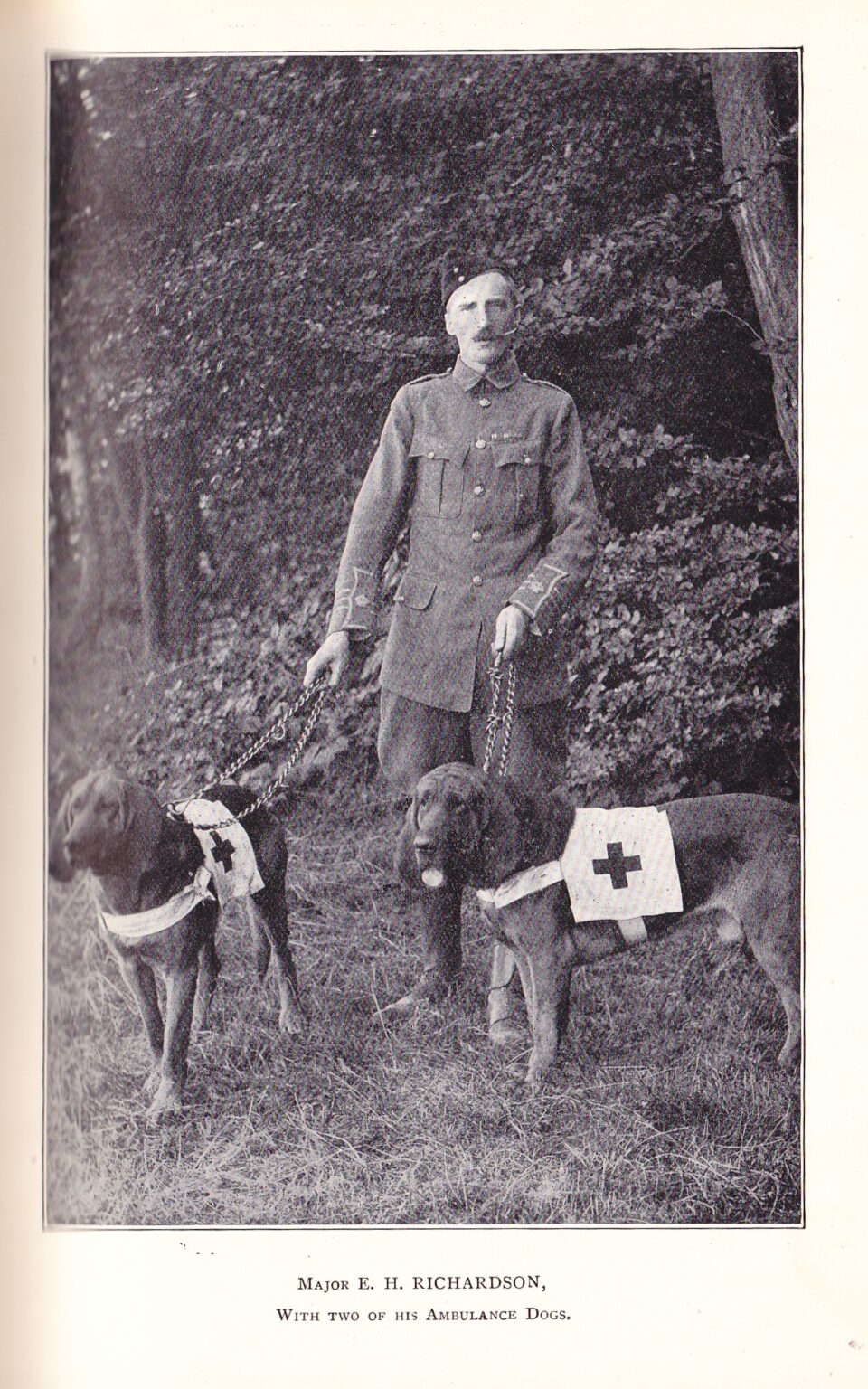
In the Sherwood Foresters 1910 Regimental Annual, Major E. H Richardson campaigned for the use of ambulance dogs. He argued that recent improvements to modern firearms were placing increasing demand on the powers of the Ambulance Corps and Army Medical Staff.

In particular, advancements to long-range weapons meant that battlefields became larger and often included sloping ground and woodland areas. As battlefields encompassed greater areas of land and became more treacherous, the work of the stretcher-bearer became greatly hindered and delayed.

According to Major Richardson, it became more likely that wounded men, who were unable to call for aid or able to move, could be overlooked by the stretcher-bearer and consequently found too late. He asked: ‘Of what use then are the latest discoveries of medicine and surgery when the subjects cannot be found?’

“By the aid of the ambulance dog it would be possible to decrease the number of missing on the field of battle, and it can be hoped almost entirely to do away with it; and the chief duty is to find the wounded in difficult ground, almost inaccessible to the stretcher-bearers, and especially in actions by night. With this object the dog is equipped with bandages, so that the wounded who find themselves still able to use their arms can take out of the equipment bandages to stop their wounds, or stimulant, before the keeper of the dogs actually reaches the stop.”

Major Richardson, 1910 Regimental Annual. 

Regimental Annual of the Sherwood Foresters, 1910. Museum of the Mercian Regiment (WFR Collection), Nottingham: Catalogue number: 1998-2052.

Mascots, morale boosters, and companions

Dogs have also provided comfort to soldiers amidst the hardships of war whilst serving in trenches, base camps, and prisoner of war camps. Battalions adopted dogs as mascots, which were thought to bring good luck to the troops, and officers often brought their pet dogs with them. As well as providing emotional comfort and maintaining group morale, these dogs also helped to guard camps and watch over their battalion.

Here are a few of the dogs who served alongside the Sherwood Foresters. . .

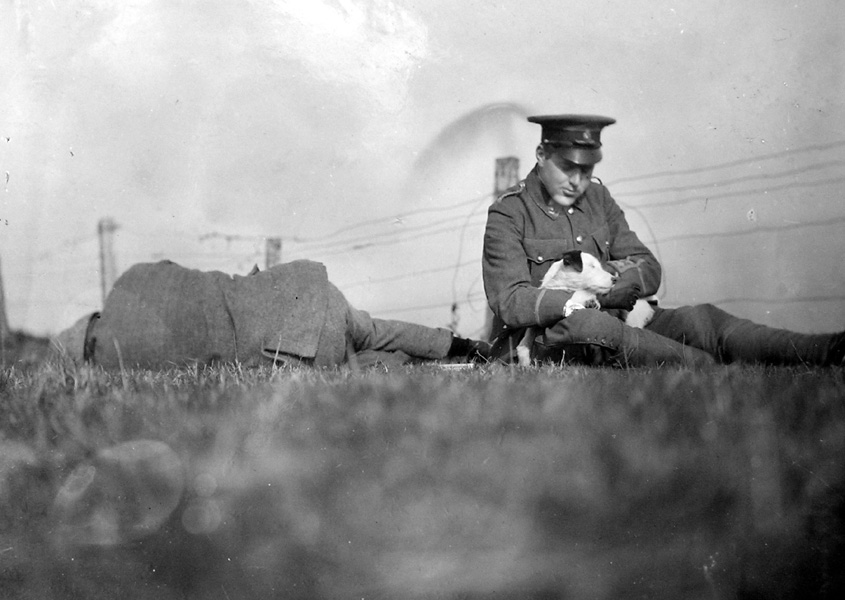
Two soldiers resting with a dog in 1907. Museum of the Mercian Regiment (WFR Collection), Nottingham: Catalogue number: 2000-3596-138.
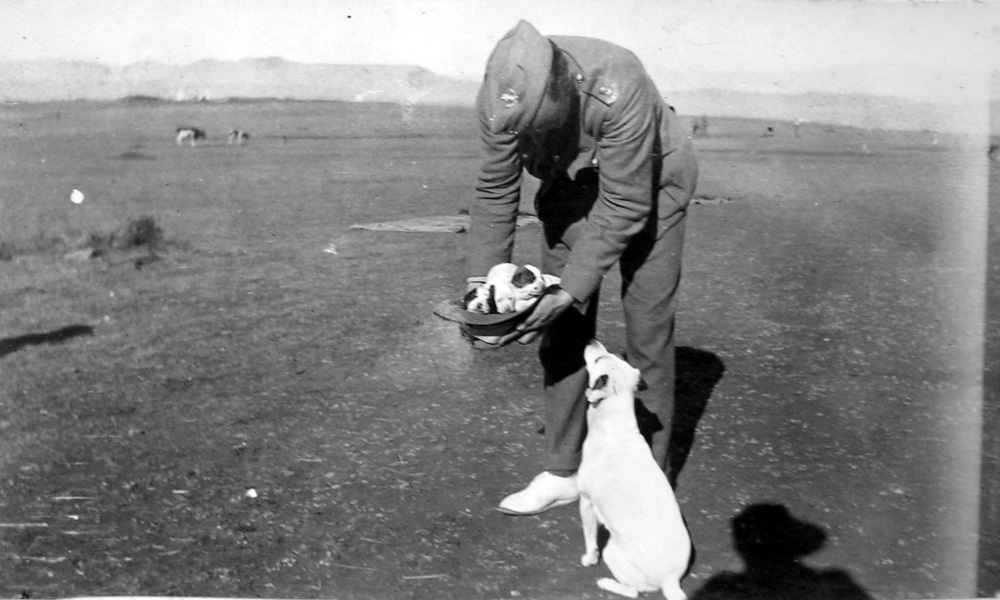
Major Cowper with his dog Tess and her puppies, 4th Battalion, South Africa 1900-02. Museum of the Mercian Regiment (WFR Collection), Nottingham: Catalogue number: 2000-3601-127.
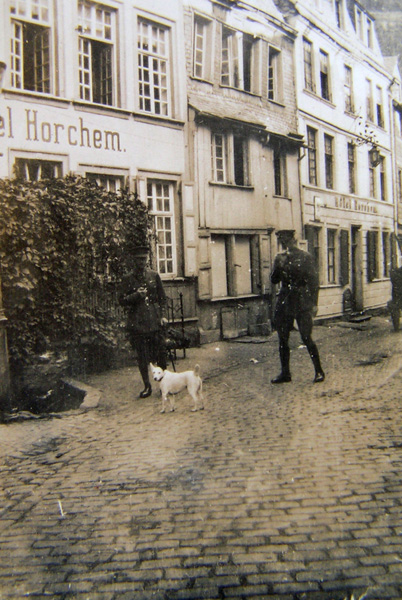
Two officers and Peter the dog on a a cobbled street in Montjoie, France. 8th Battalion, 1907-1919. Museum of the Mercian Regiment (WFR Collection), Nottingham: Catalogue number: 1997-654-298.
Sitting portrait of Captain G.W. Cosens with his dog circa 1864. Museum of the Mercian Regiment (WFR Collection), Nottingham: Catalogue number: 2000-3619-28.
A small dog called Bingo, a mascot wearing a jacket embroidered with battle honours of the 45th of Foot. Museum of the Mercian Regiment (WFR Collection), Nottingham: Catalogue number: 2000-3627-59.

War Dogs in Malaya

In 1958, the 1st Battalion reverted to an infantry role and took part in the closing stages of the Malayan Emergency (1948-1960).

In 1951, the British Army established a school in Kota Tinggi, Malaysia, to provide comprehensive training before these dogs graduated as fully trained elite ‘War Dogs’.

These highly trained dogs could navigate the challenging jungle environment with ease and were deployed to discover anti-terrorist activities and locate hidden insurgents. German Shepherds and Labradors were the breed of choice due to their intelligence and tracking abilities.


Photograph of the training of a War Dog at Palace Barracks Belfast. Museum of the Mercian Regiment (WFR Collection), Nottingham. Catalogue number: 1997-592-288.

Recognising their service

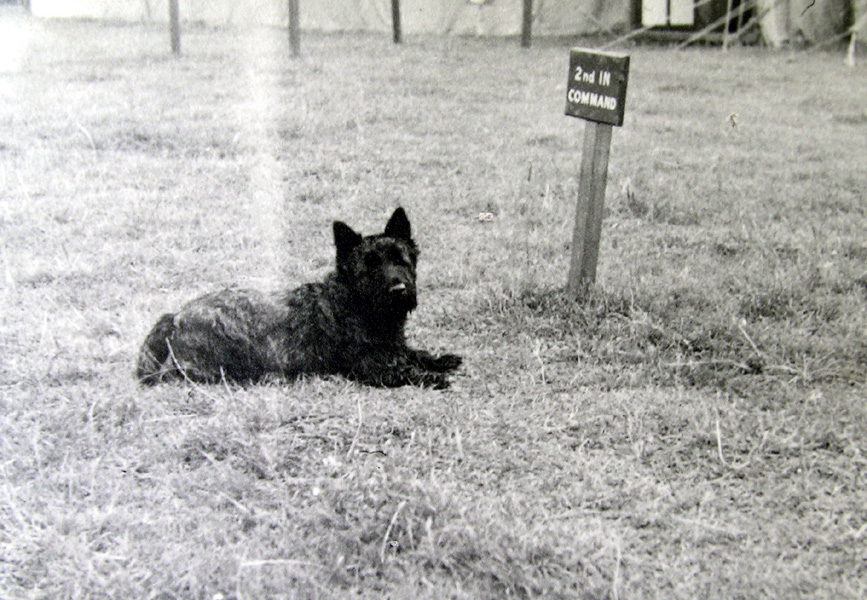
A black dog called "Sally" at the camp held at Halton in 1938. Museum of the Mercian Regiment (WFR Collection), Nottingham. Catalogue number: 2000-3622-181.

Despite their significant contributions to the war effort, medals were not awarded to animals until 1943, when The Dickin Medal was first instituted. The Dickin Medal remains the highest form of honour that can be bestowed upon an animal for their service during military conflict.

The first animals to receive this medal were three messenger pigeons named White Vision, Winkie, and Tyke who served in the Royal Air Force during World War Two. It was not until the following year that a dog first received the medal. On the 24th March 1944, a mixed-breed dog named Bob was rewarded for his devotion to duty with the 6th Battalion Queens Own Royal West Kent Regt in North Africa. 

Since then, a total of 75 recipients have been awarded the medal, with 38 dogs, 32 messenger pigeons, 4 horses and 1 cat being given the honour.

Want to learn more about animals in the British Army?

Follow these links:

https://www.iwm.org.uk/history/15-animals-that-went-to-war
 
https://www.iwm.org.uk/history/9-famous-animals-from-the-first-and-second-world-wars
 
https://www.archives.gov/publications/prologue/1996/fall/buddies.html
 
https://www.nam.ac.uk/subjects/animals

Liked what you have read?

If you have liked what you have seen and learnt then please donate to our museum fund in the link below. As a museum we are a registered charity (No.1001226) and rely heavily on monetary donations to keep the museum going. Help us to keep the museum and its collection going for future generations and keep sharing the history of The Sherwood Foresters, WFR & Mercian Regiment! 

References: 

 Museum of the Mercian Regiment (WFR Collection), A small dog called Bingo, a mascot wearing a jacket embroidered with battle honours of the 45th of Foot. Nottingham: Catalogue number: 2000-3627-59.

Museum of the Mercian Regiment (WFR Collection), A black dog called “Sally” at the camp held at Halton in 1938. Nottingham. Catalogue number: 2000-3622-181.

Museum of the Mercian Regiment (WFR Collection), Major Cowper with his pet dog Tess and her puppies, 4th Battalion, South Africa 1900-02. Nottingham: Catalogue number: 2000-3601-127.

Museum of the Mercian Regiment (WFR Collection), Photograph of a street scene at Kortrijk, France, Circa 1914-1918. Nottingham: Catalogue number: 2000-3637-90.

Museum of the Mercian Regiment (WFR Collection), Photograph of the training of a War Dog at Palace Barracks Belfast. Nottingham. Catalogue number: 1997-592-288.

Museum of the Mercian Regiment (WFR Collection), Regimental Annual of the Sherwood Foresters, 1910. Nottingham: Catalogue number: 1998-2052.
 Museum of the Mercian Regiment (WFR Collection), Sitting portrait of Captain G.W. Cosens with his pet dog, circa 1864. Nottingham: Catalogue number: 2000-3619-28.

Museum of the Mercian Regiment (WFR Collection), Two officers and Peter the dog on a a cobbled street in Montjoie, France. Nottingham: Catalogue number: 1997-654-298. 

Museum of the Mercian Regiment (WFR Collection), Two soldiers resting with a dog in 1907. Nottingham: Catalogue number: 2000-3596-138.

 Regimental Annual: The Sherwood Foresters, Nottinghamshire and Derbyshire Regiment, 1910. Museum of the Mercian Regiment (WFR Collection), Nottingham: Catalogue number: 1998-2052.